Sexual Assault Awareness Month
April is Sexual Assault Awareness Month
April is Sexual Assault Awareness Month (SAAM), a national program bringing attention to the issue of interpersonal violence. Every year, the Women’s Center creates community for survivors who might feel like they’re alone, who might think their communities don’t care, and who want to take action to make the world a safer place for everyone. Join the NC State Women’s Center and our campus partners for a variety of engaging opportunities, workshops and events featuring leaders on our campus as we honor the strength, courage, and resiliency of NC State survivors and work together to create a stronger and safer campus community.
Sexual assault is too common an experience: 1 in 4 women and 1 in 7 men will experience sexual assault in their lifetimes. Preventing sexual assault requires all of us: holding others and ourselves accountable, showing up for survivors, and being in solidarity with those whose experiences may be different than ours.
Calendar of Events
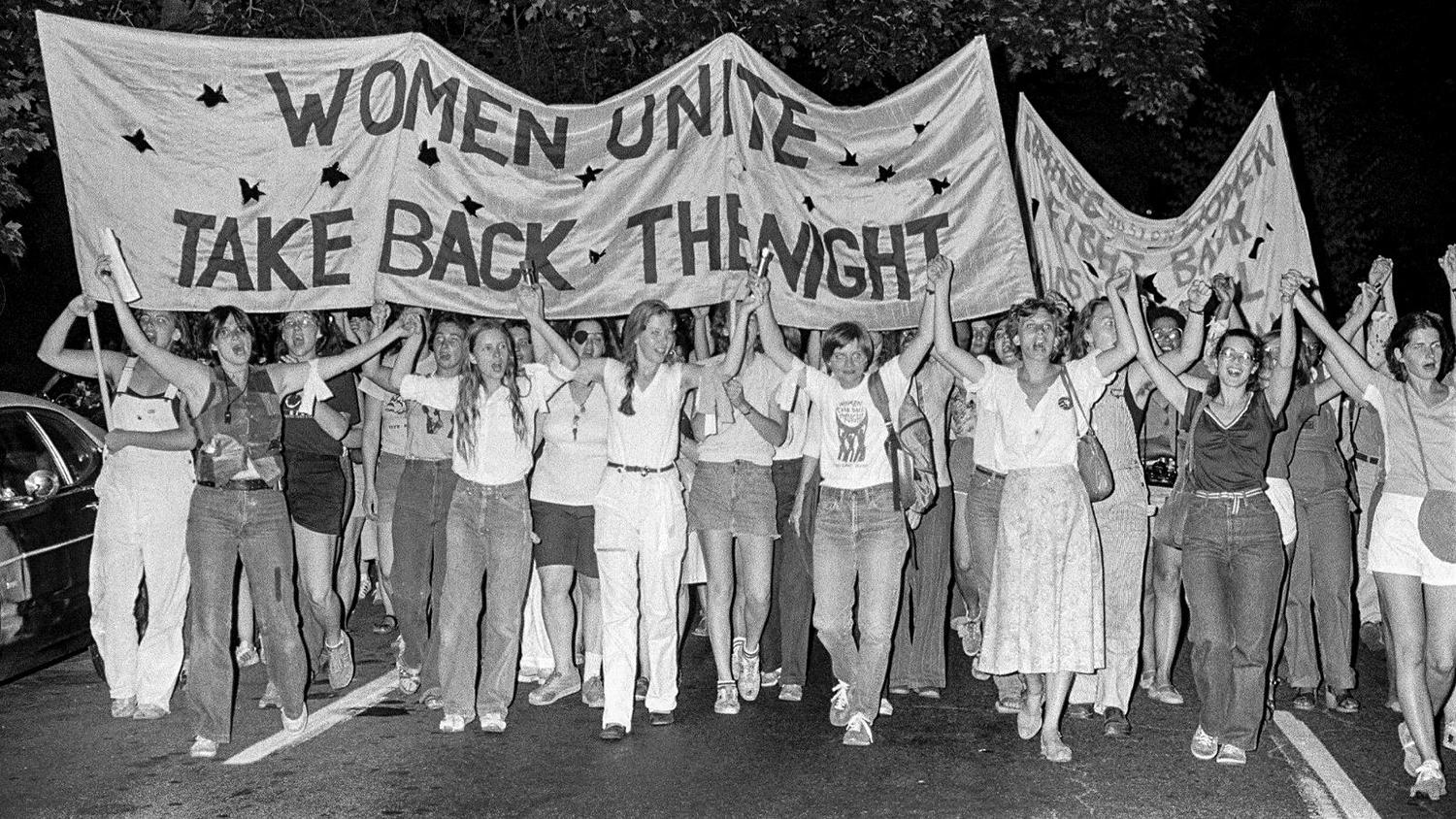
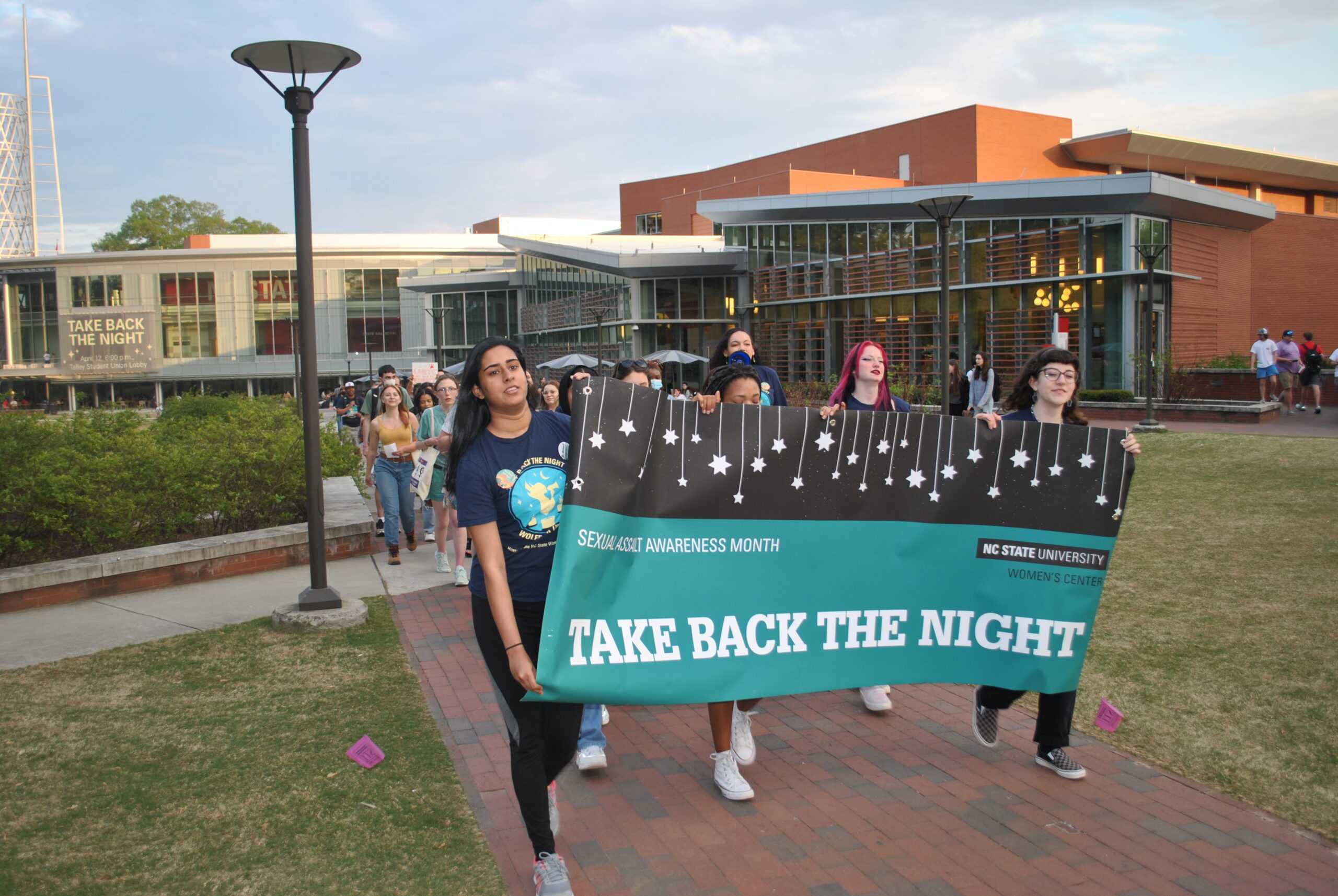
Take Back the Night at NC State
In the News
The Women’s Center’s Take Back the Night event is making its annual march through campus – The Technician (April 1, 2026)
Unpacking the sexual assault “red zone” – The Technician (Sept 25, 2024)
Resources on NC State’s campus for survivors of sexual assault – The Technician (Sept 23, 2024)
Take back the night empowers survivors, builds community – The Technician (Apr 17, 2024)
Women’s Center Library Selections
Come check out any of these books from the Women’s Center library in 5210! You can browse our catalog here through the library website.
At the Dark End of the Street: Black Women, Rape, and Resistance–A New History of the Civil Rights Movement from Rosa Parks to the Rise of Black Power | Danielle L. McGuire
McGuire’s history of the sexual violence as central to Black freedom struggles provides a vital perspective to histories of civil rights and sexual violence activism. Though this can be a difficult read because of its account of violence, it is also inspiring, as McGuire herself notes: Black women were vocal and protested attacks on their lives. At the Dark End of the Street offers a plethora of political and theoretical resources for readers.
Is Rape a Crime? A Memoir, an Investigation, and a Manifesto | Michelle Bowdler
Award-winning writer and public health executive Michelle Bowdler’s memoir confronts how sexual violence has been addressed for decades in our society, asking whether rape is a crime given that it is the least reported major felony, least successfully prosecuted, and fewer than 3% of reported rapes result in conviction. Cases are closed before they are investigated, and DNA evidence sits for years untested and disregarded. Given all this, it seems fair to ask whether rape is actually a crime. Twenty years later, after a career of working with victims like herself, Bowdler decided to find out what happened to her case and why she never heard from the police again after one brief interview. Is Rape a Crime? is an expert blend of memoir and cultural investigation.
Unbound: My Story of Liberation and the Birth of the Me Too Movement | Tarana Burke
Tarana Burke is the founder and activist behind the largest social movement of the 20th and 21st centuries, the me too movement, but first she had to find the strength to say ‘me too’ herself. Unbound is the story of how she came to those two words, after a childhood growing up in the Bronx with a loving mother that took a terrible turn when she was sexually assaulted. Tarana’s debut memoir explores how to piece back together our fractured selves. How to not just bring the me too movement back to empathy, but how to empathize with our past selves, with our bad selves, and how to begin to love ourselves unabashedly. This is her story of finding that for herself, and then spreading it to an entire world.
#MeToo and Literary Studies: Reading, Writing, and Teaching about Sexual Violence and Rape Culture | Edited by Mary K. Holland and Heather Hewett
#MeToo and Literary Studies gathers essays on literature from Ovid to Carmen Maria Machado, by academics working across the United States and around the world, who offer clear ways of using our reading, teaching, and critical practices to address rape culture and sexual violence. It also examines the promise and limitations of the #MeToo movement itself, speaking to the productive use of social media as well as to the voices that the movement has so far muted.
We Believe You: Survivors of Campus Sexual Assault Speak Out | Annie E. Clark and Andrea L. Pino
Across the U.S. student activists are exposing a pervasive cover-up of sexual violence on college campuses. Every day more survivors come forward. But other survivors choose not to. We Believe You elevates the stories the headlines about this issue have been missing – more than 30 experiences of trauma, healing and everyday activism, representing a variety of voices, economic and family backgrounds, gender identities, immigration statuses, interests, capacities and loves. From young people at the forefront of the movement to end sexual assault on college campuses, Clark and Pino offer a collection of survivor stories that will connect with students and inform and inspire us all.
Support is Available
** If you or someone you know is experiencing relationship violence, sexual violence, stalking or any other form of interpersonal violence and are in need of advocacy services, the NC State Women’s Center has trained advocates available to offer crisis intervention, emotional support, resources, and referrals. Students can contact the 24/7 Sexual Assault Helpline at 919-515-4444 or ncsuadvocate@ncsu.edu to be connected with an advocate.
Advocacy services through the NC State Women’s Center are available for all students inclusive of all gender identities and sexual orientations.
For more information on advocacy services, please visit go.ncsu.edu/supportsurvivors. You may also visit go.ncsu.edu/safe for additional information on resources and reporting options.